logosm.jpg

 
Ask Us A Question Here
 
A Bird's Home
 
A Birder's Resources
 
Become an Affiliate
 
Coveside Bat Houses
 
Coveside Birdhouse Features
 
Coveside Bluebird Houses
 
Coveside Chickadee Houses
 
Coveside Conservation Products
 
Coveside Duck Houses
 
Coveside Flycatcher Houses
 
Coveside Kestrel Houses
 
Coveside Nuthatch Houses
 
Coveside Owl Houses
 
Coveside Purple Martin Houses
 
Coveside Swallow Houses
 
Coveside Testimonials
 
Coveside Titmice Houses
 
Coveside Warbler Houses
 
Coveside Wild Bird Feeders
 
Coveside Window Feeders
 
Coveside Woodpecker Houses
 
Coveside Wren Houses
 
Dealer Wholesale Account Information
 
Photo Gallery
 
Product Reviews
 
The Registry of Nature Habitats Certification
 
Dealer Account Information
 
Coveside Kestral Houses
 
Cypripedium - Lady Slipper Orchids
Bird feedersBirdhousesBird Houses Bird Feeders

Search for products for sale only!

Click on any product image to see larger image of product.
Bookmark - Add us to your Favorites

>


Google

Coveside Purple Martin Houses

COVESIDE CONSERVATION PRODUCTS

PURPLE MARTINS:
Dependent Upon Humans

Purple Martin House
Purple Martin Houses


CONTENTS:

LINKS:
Need For Birdhouses
Attracting Purple Martins

More Info On Purple Martins

Need For Birdhouses

One of the favorite birds of people who are not necessarily serious students of other types of bird is the Purple Martin. This friendly fellow returns the affection by preferring to live around humans.

The Purple Martin (Progne subis)has been lovingly housed by many for nostalgic reasons -- their grandparents and parents had martin houses. And this bird, for whom everyone watches eagerly in the spring, comes back to his established home year after year.

But the martin is a species which needs humans for a number of reasons. Many factors, such as insecticide spraying, have contributed to a reduction in their number, and martins need our help in removing such deadly threats. Young martins have a high mortality rate (more than 75% of fledgling martins die during their first year of life). And 50% of adults die each year. They are particularly vulnerable to bad weather, to starvation, and to extreme heat. They have several natural predators, including snakes, raccoons, cats, squirrels, hawks, and owls, which raid their nests, and competing birds who nest in their houses if given the opportunity (particularly House Sparrows and Starlings).

A Purple Martin landlord cannot simply erect a martin house, sit back, and enjoy watching his new colony of graceful birds swooping through the air in pursuit of insects. He (or she) must diligently fend off the competition and predators, clean out any sparrow nests, clean out the martin nests at the end of the season, and plug the entrance holes for the winter.

If he is undaunted in this role of landlord, the martin will reward his efforts, filling his birdhouses each year with family upon family of this delightful aviary companion and devouring a wide variety of insects flying about his yard.

A Purple Martin will range over an area of about four square miles. He drinks fresh water only, dipping down to catch a drink "on the wing." His house may be as close to or as far away from other martin houses as his landlord desires; he has no preference in this matter.

Martins need a source of calcium, and martin lovers may place crushed eggshell or oyster shell nearby for the birds. The eggshell should be washed first to eliminate any bacteria.

Martins may move into a new home the day it is put up, or it may take ten years for them to nest in it.

Attracting Purple Martins

To attract Purple Martins to a birdhouse, the house should be placed in an open space, at least 40 to 60 feet from any trees taller than it is, preferably within a few hundred feet of human habitation. The birds need a wide space to approach the house from at least two sides, and they seem to know that people will protect them from their natural predators. The activity of people does not seem to bother them at all.

The house should be mounted 10 to 20 feet off the ground, preferably on a telescoping pole so that it can be lowered for easy cleaning and for checking on the young in the nests. A predator guard on the pole is also highly desirable. The house should not be moved, once martins have taken up residence in it, as they will reject it the following year if it is in a new location.

If any other species of bird nests in the martin house before the martins arrive, the house will not attract martins. This may involve frequent, even daily, lowering of the house to evict unwanted tenants, or plugging the entrance holes until the martins arrive.

The houses which are most successful in attracting martins are of a light color. This helps to keep the house cool in the summer's heat and highlights the dark entrance holes. Ventilation holes also keep the birds from perishing on hot days.

The birdhouses should not be opened up until about four weeks after the first martins are scheduled to arrive in the area. The first to arrive, commonly called "scouts," are not really scouts, but are merely the oldest martins. Older martins cannot be attracted to new locations, because they have high loyalty to the exact home where they bred in the past. Usually only the previous year's fledglings can be attracted to unestablished sites, and they begin returning to an area about 4 to 5 weeks after the "scouts."

Bushes and shrubs growing beneath the martin house should be removed, as this attracts predators such as cats, and martins will avoid the house. Similarly, they will avoid houses which can be reached by squirrels, even by a wire.

A landlord probably cannot have too many martin houses, as most places will support several hundred breeding pairs per square mile. And, while Purple Martins live on flying insects, there is no scientific data to show that mosquitoes form a significant portion of this diet.

A "colony" of Purple Martins consists merely of more than one breeding pair in a given house. They are not necessarily related to each other.

back to top...

   
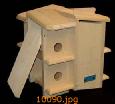
Coveside Purple Martin House
$169.95

In the East, Purple Martins are attracted to houses with multiple apartments to establish colonies. This house opens on four sides for easy cleaning and mounts securely on a pole.
RANGE: Breeds from British Columbia, central interior Canada and Nova Scotia southward, but absent from interior western mountains and Great Basin. Winters in tropics.
HABITAT: Seeks open woodlands, residential areas and agricultural land.

(18"h x 17-1/2"w x 17-1/2"d)


add_to_cart.gif  view_cart.gif

   
Coveside Wood Chips Nesting Material
$1.99
Nesting Material. Gallon size.
add_to_cart.gif  view_cart.gif

Support

The Registry of Nature Habitats - Buy Conservation Credits


For purchasing Conservation Credit(s)
You will receive
a copy of the John Audubon Multimedia CD
A replica of the complete (1840-1844)
James Audubon's Birds of America

You will also receieve a bluebird house for each Conservation Credit purchased and a 20% off coupon to be used on the A Bird's Home website!


Conservation Certificates

The Registry of Nature Habitats - Mission Statement

The Registry of Nature Habitats is dedicated to the preservation of land that, over time, has been a site and home for complex ecosystems. The Registry advocates preservation of these lands and its inhabitants, environmental education for community individuals and groups, and nurturing of these lands through restoration in order to conserve its natural resources for future generations.

Preserve

The Registry of Nature Habitats manages critical habitat, consisting of wetland, lowland, upland, forest and stream habitat, providing a home to wildlife species and plant species. As part of the mission to preserve these lands and its inhabitants, the Registry will continue to contract with owners of ecologically sensitive land as it becomes available.

Educate

The Registry of Nature Habitats is a "teaching ground," able to provide hands-on, interpretive learning experiences in areas such as ecology, botany, wildlife science, and geology, as well as the arts and humanities. The educational mission of The Registry of Nature Habitats is to teach an understanding and appreciaton of the environment, the invaluable lesson of land stewardship of our natural resources, and to expand the general knowledge of this habitat through scientific research. This will be accomplished through a year-round experiential, interactive approach, along with onsite and outreach activities including providing educational material both on this website, on media and through educational seminars. An on-site facility is in the design phase, which will house classrooms and an administrative space.

Nurture

Through several restoration projects, including the rebuilding of stream corridors, reintroducing native flora, and permitting only low-impact activities, the Registry is nurturing much land back to its natural state, undoing the damage of hundreds of years. The Registry of Nature Habitats restoration plan, developed with public and private partnerships and with local community support, will increase the land's value, enhance wildlife habitat, improve water quality, and preserve the integrity of the land's bio-diversity.

Renewable Energy

Promote the use of renewable and efficient energy technologies through education, training, workforce development, research, and project facilitation. The Registry supports clean energy development and energy conservation as the means to protect the environment, enhance public health, and save our nature habitats.

Conservation

We seek to educate people and provide innovative solutions that will help build a clean, more efficient world, by reducing energy consumption in a prudent way that does not threaten the natural balance that supports all life.


Duck Decoy Loon Lake Heartwood magnolia Coast

Wholesale Dealer Inquiries Invited

Home Page | Product Review Page | Join Our Affiliate Program | Links | Help

Favorite Bird Guestbook | All About Purple Martins
Contact Us | Report Site Errors | Suggestions/Comments | Privacy Notice
Voting Booth | Site Survey | Bird & Nature Link Resources | Bird & Nature Bulletin Board

Visit The Registry of Nature Habitats and apply to admit your property. Receive many benefits in addition to 10% discount on all products offered by A Bird's Home.

Tell A Friend About This Web Site:

Your Name
Your Email
Friend's Name
Friend's Email
A Quick Note

Privacy Info: We DO NOT store your name, your email, your friends name, or your friends email in any form. It is ONLY used to generate an email message.

Join Our Mailing List!
Email First Name Last Name

Visit Our Partners:

The Home Stores | A Coffee Bean's Home | Jim Miller Golf | Reigning Cats & Dogs | MSBL Sports | A Pond's Home | A Plant's Home | Sawkill Forest| An Instrument's Home


Bird feeders
(607) 746-3089
PO Box 321
Meridale, NY 13806
More information Help Desk

Copyright � 1997- Woodside Gardens
Last Updated: