|
|
Search
for products for sale only! | |
|
|
Click on any product image to see
larger image of product.
 |
Bookmark - Add us to your
Favorites |
Coveside Kestral Houses
|
COVESIDE CONSERVATION
PRODUCTS
KESTRELS: Small
Falcons |
 |
Kestrel
Houses for
sale |
|
|
|
|
CONTENTS: |
|
LINKS: |
|
|
|
|
|
|
|
|
|
|
|
|
|
|
|
|
|
|
|
|
|
|
Sparrow
Hawk
The
American Kestrel (Falco sparverius) is the smallest and most common
of our falcons. It was formerly called the Sparrow Hawk, and has
sometimes been known as the Killy Hawk because of its call, a high
killy-killy-killy. It is found in all states, but spends only warmer
months in northern states and Canada.
The
kestrel feeds on large insects, for the most part, and small mice and
voles. It occasionally will also catch and eat a small bird (chiefly
the House Sparrow in urban areas) or a reptile. Unlike the other
falcons, it captures its prey on the ground, rather than in the air. A
kestrel may perch in a tree, watching for its prey, and then fly down and
hover in the air directly over a grasshopper, waiting for the proper
moment to seize it in its talons. Then it flies up to its perch to eat
it.
Kestrels
may be attracted to birdhouses, as they do not excavate their own holes,
and large woodpecker holes are hard to find. This may be a more
important factor in controlling the size of the kestrel population than
the food supply.
The
kestrel is a jay-sized bird, 9" to 12" long with a 21" wingspan and a
striking appearance. It is recognized by its rusty tail and back,
and the double black stripes on its white face. The adult female has
brown wings, while the male's are pale steel-blue.
They are
comfortable with people and live in rural areas and open country as well
as in towns and cities, if food and habitat are available. Kestrel
populations have been threatened by loss of habitat, due to such practices
as cutting hedgerows, the loss of hay and old fields in favor of row
crops, and by pesticides which contaminate their food.
Once a
male and female have paired off in the spring and chosen a nest site, the
female remains near the nest and the male brings her food to
her. When he comes near the nest, he calls her, and she flies to him
to receive her food away from the nest.
The female
lays 4 to 5 whitish eggs with small brown dots, which are incubated for 30
days by only the female, the male bringing her food throughout this period
and into the nestling phase. The young fledge in two weeks, and
after leaving the nest they perch together in trees, waiting for their
parents to bring them food. It is not uncommon for families to be
together into the late summer. Kestrels raise one brood per
year.
Coveside's
Kestrel House is unique in that it provides a "perch" for the mother just
inside the entrance hole. Being a bird of prey, she sits and watches for
the next meal to appear for her little ones.
Mounting a Nest Box
The
American Kestrel prefers open country, especially parks, farmlands, and
open areas adjacent to woodlands. Place the box on a tree or tall
cactus near an open area, between 10 and 30 feet above the ground.
Keep branches away from the box opening.
They will
readily use a nest box placed in an open area, even along a highway, and
the more that are put up, the more kestrels will live in the area.
Because of the bird's tendency to sometimes eat other small birds, you may
wish to place the box away from those for other species. Placing the
house in fields or orchards may benefit crops, as the kestrels will eat
harmful voles and insects.
The
kestrel does not line its nest, but some experts recommend providing wood
chips (not sawdust, which can hurt the baby kestrel's eyes).
back to top...
|
|
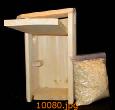
Coveside American Kestrel House
$49.95
Formerly called the Sparrow Hawk, the kestrel eats insects
and small rodents. House includes an internal perch (shown in photo with door
open) so mother and babies can keep an eye out for their next
meal. RANGE: Breeds from Alaska and Northwest
Territories east through Maritime Provinces, and south throughout continent.
Winters north to British Columbia, Great Lakes and New
England. HABITAT: Lives in towns and cities, parks,
farmlands, along highways and in open country. (17-3/4"h x 9-1/2"w x 11"d)
|
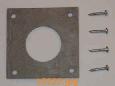
Coveside Slate Squirrel Guard
$5.95
This guard is used
with the following nesting houses: Window Nest Box,
Chickadee, Nuthatch, Titmouse, House Wren, all Bluebird Houses, Saw-Whet Owl
and Kestrel. This guard will protect the box from chewing
squirrels.
|
Coveside Wood Chips Nesting Material
$1.99
Nesting Material. Gallon size.
|
Support The Registry of Nature Habitats - Buy Conservation Credits For purchasing Conservation
Credit(s) You will receive a copy of the John Audubon Multimedia
CD A replica of the complete
(1840-1844) James Audubon's
Birds of America
You will also receieve a bluebird
house for each Conservation Credit purchased and a 20% off coupon to be used on
the A Bird's Home website!
 The Registry of Nature Habitats - Mission
Statement
The Registry of Nature Habitats is
dedicated to the preservation of land that, over time, has been a
site and home for complex ecosystems. The Registry advocates
preservation of these lands and its inhabitants, environmental
education for community individuals and groups, and nurturing of
these lands through restoration in order to conserve its
natural resources for future generations.
Preserve
The Registry of Nature
Habitats manages critical habitat, consisting of wetland,
lowland, upland, forest and stream habitat, providing a home
to wildlife species and plant species. As part of
the mission to preserve these lands and its inhabitants,
the Registry will continue to contract with owners
of ecologically sensitive land as it becomes
available.
Educate
The Registry of Nature Habitats is
a "teaching ground," able to provide hands-on, interpretive learning
experiences in areas such as ecology, botany, wildlife science, and
geology, as well as the arts and humanities. The
educational mission of The Registry of Nature Habitats is
to teach an understanding and appreciaton of the environment,
the invaluable lesson of land stewardship of our natural resources,
and to expand the general knowledge of this habitat through
scientific research. This will be accomplished through a
year-round experiential, interactive approach, along
with onsite and outreach activities including providing
educational material both on this website, on media and through
educational seminars. An on-site facility is in the
design phase, which will house classrooms and an administrative
space.
Nurture
Through several restoration
projects, including the rebuilding of stream corridors,
reintroducing native flora, and permitting only low-impact
activities, the Registry is nurturing much land back to
its natural state, undoing the damage of hundreds of
years. The Registry of Nature
Habitats restoration plan, developed with public and private
partnerships and with local community support, will increase
the land's value, enhance wildlife habitat, improve water
quality, and preserve the integrity of the land's
bio-diversity. Renewable
Energy
Promote the use of
renewable and efficient energy technologies through education,
training, workforce development, research, and project facilitation.
The Registry supports clean energy development and energy
conservation as the means to protect the environment, enhance
public health, and save our nature
habitats.
Conservation
We seek to educate people and provide innovative
solutions that will help build a clean, more efficient world, by
reducing energy consumption in a prudent way that does not
threaten the natural balance that supports all
life.
|
|
|