
|
|
Search
for products for sale only! | |
|
|
Click on any product image to see
larger image of product.
 |
Bookmark - Add us to your
Favorites |
Coveside Nuthatch Houses
|
|
|
|
|
|
|
|
|
|
COVESIDE CONSERVATION PRODUCTS
NUTHATCHES: Little
Acrobats!
|

|
Nuthatch Houses for sale
|
|
|
|
|
CONTENTS:
|
|
LINKS:
|
|
|
|
|
|
|
|
|
|
|
|
|
|
|
|
|
|
The nuthatch is a short-tailed
bird known for its acrobatics, running up and down and all around trees,
but especially for coming down the tree head-first!
Four
species live in North America (White-breasted, Red-breasted, Pygmy, and
Brown-headed), and even though they do not take to nesting boxes as well
as some other birds, they are cavity-dwelling birds and are worth trying
to attract.
Their name
comes from their habit of pushing a nut into a crevice in the bark of a
tree, and then pounding it, appearing to try to "hatch" it.
White-breasted Nuthatch
The
White-breasted Nuthatches (Sitta carolinensis) are found in nearly
all states in beeches and oaks in the east, and in oaks and conifers in
the west. They have black caps over white faces, with gray backs,
short tails, and long, narrow bills. With no great musical talent,
these birds give a call that is nasal sounding, either a rapid series of
whistles on one pitch, or a one low nasal note. This bird is more
widespread and more common at feeders than its red-breasted cousin.
It can even be taught to eat from human hands.
This
nuthatch feeds on insects gleaned from the bark of tree trunks and the
nuts of deciduous trees. It loves acorns and beechnuts and also likes
pine seeds, grain waste, and the seeds and berries of other
plants. It stores food in the fall under loose tree bark. At
feeders it likes sunflower seeds, suet, peanut butter, nutmeats, and
cracked corn and millet.
Red-breasted Nuthatch
The
Red-breasted Nuthatch (Sitta canadensis) is slightly smaller, with
a distinctive black stripe across the eye and a rust-colored
breast. It is also a bird of the forest, preferring conifers or mixed
woods in nearly every part of the country. It digs a hole in soft,
decaying wood and smears the entrance hole with pitch. They are messy
nest-builders, so don't open the nesting box while it is occupied, or it
may all fall out.
The
Red-breasted Nuthatch feeds primarily on conifer seeds and insects in tree
bark. They store food as well and enjoy suet, peanut butter, nuts and
sunflower seeds at a feeder.
back to top...
|
|
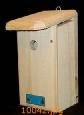
Coveside Nuthatch House
$29.95
Nuthatches are secondary cavity dwellers so they
look for a nesting location that has already been established naturally or by
another bird. Locate housing away from buildings in a
mature forest as best protection from house sparrows.
RANGE: Resides throughout eastern U.S. except southern
Florida. HABITAT: Likes mixed woodlands, village trees and
orchards. (12-1/2"h x 6"w x
8-1/2"d)
|
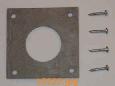
Coveside Slate Squirrel Guard
$5.95
This guard is used
with the following nesting houses: Window Nest Box,
Chickadee, Nuthatch, Titmouse, House Wren, all Bluebird Houses, Saw-Whet Owl
and Kestrel. This guard will protect the box from chewing
squirrels.
|
Coveside Wood Chips Nesting Material
$1.99
Nesting Material. Gallon size.
|
Coveside Wood Predator Guard
$5.95
Used to protect
baby birds form predators reaching in and grabbing
them.
|
Support The Registry of Nature Habitats - Buy Conservation Credits For purchasing Conservation
Credit(s) You will receive a copy of the John Audubon Multimedia
CD A replica of the complete
(1840-1844) James Audubon's
Birds of America
You will also receieve a bluebird
house for each Conservation Credit purchased and a 20% off coupon to be used on
the A Bird's Home website!
 The Registry of Nature Habitats - Mission
Statement
The Registry of Nature Habitats is
dedicated to the preservation of land that, over time, has been a
site and home for complex ecosystems. The Registry advocates
preservation of these lands and its inhabitants, environmental
education for community individuals and groups, and nurturing of
these lands through restoration in order to conserve its
natural resources for future generations.
Preserve
The Registry of Nature
Habitats manages critical habitat, consisting of wetland,
lowland, upland, forest and stream habitat, providing a home
to wildlife species and plant species. As part of
the mission to preserve these lands and its inhabitants,
the Registry will continue to contract with owners
of ecologically sensitive land as it becomes
available.
Educate
The Registry of Nature Habitats is
a "teaching ground," able to provide hands-on, interpretive learning
experiences in areas such as ecology, botany, wildlife science, and
geology, as well as the arts and humanities. The
educational mission of The Registry of Nature Habitats is
to teach an understanding and appreciaton of the environment,
the invaluable lesson of land stewardship of our natural resources,
and to expand the general knowledge of this habitat through
scientific research. This will be accomplished through a
year-round experiential, interactive approach, along
with onsite and outreach activities including providing
educational material both on this website, on media and through
educational seminars. An on-site facility is in the
design phase, which will house classrooms and an administrative
space.
Nurture
Through several restoration
projects, including the rebuilding of stream corridors,
reintroducing native flora, and permitting only low-impact
activities, the Registry is nurturing much land back to
its natural state, undoing the damage of hundreds of
years. The Registry of Nature
Habitats restoration plan, developed with public and private
partnerships and with local community support, will increase
the land's value, enhance wildlife habitat, improve water
quality, and preserve the integrity of the land's
bio-diversity. Renewable
Energy
Promote the use of
renewable and efficient energy technologies through education,
training, workforce development, research, and project facilitation.
The Registry supports clean energy development and energy
conservation as the means to protect the environment, enhance
public health, and save our nature
habitats.
Conservation
We seek to educate people and provide innovative
solutions that will help build a clean, more efficient world, by
reducing energy consumption in a prudent way that does not
threaten the natural balance that supports all
life.
|
|
|