
|
|
1 2
Search
for products for sale only! | |
|
|
Click on any product image to see
larger image of product.
 |
Bookmark - Add us to your
Favorites |
Coveside Conservation Products
Manufacturer
of Wooden Birdhouses, Bird Feeders, Bat Houses and Other Wildlife Products
since 1990
|
|
|
|
|
|
|
|
|
|
|
|
|
|
|
|
|
|
|
| |
|
|
|
|
|
|
|
|
|
|
|
ABOUT SPECIFIC
SPECIES
|
|
|
|
|
|
|
|
|
|
|
|
|
|
|
|
|
|
|
|
|
|
|
|
|
|
|
|
|
|
|
|
|
|
|
|
|
|
|
|
|
|
|
|
|
|
|
|
|
|
|
|
|
|
|
|
|
|
|
|
|
|
|
|
|
|
|
|
- Designed
for the Species
- Protection from
Elements
- Ventilation, Drainage
& Insulation
- Rough Interior
- No Perch
- Easy to Clean
- Durability

|
|
|
|
|
 |
|
|
|
|
|
|
|
|
|
|
|
|
|
|
|
|
|
|
|
|
|
|
|
|
|
|
|
|
|
|
|
|
|
|
|
|
|
|
|
WHY COVESIDE?
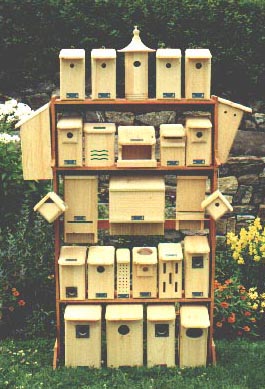
Coveside manufactures
a nest box for every species of cavity-nesting bird in North America. Designed
for each species by experts, our products provide the correct dimensions,
materials, ventilation and drainage. For instance, Sunshine's Bat House was
developed by Amanda Lollar, an internationally recognized authority on bat
behavior and director of Bat World, a sanctuary in Mineral Wells, Texas.
Coveside's products are
handcrafted in Maine from eastern white pine. Each item is constructed to
last and includes a brochure that describes the species, and the placement
and maintenance of the product.
|
|
|
|
|
|
|
|
|
|
|
|
|
|
|
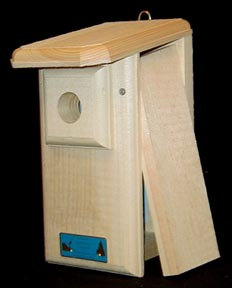
Coveside Small Winter Roosting House
$39.95
This
economical winter roost provides protection from the cold for most common
backyard birds including wrens, chickadees, nuthatches, titmice and
bluebirds. The 1-1/2" hole located at the bottom of the
front panel is protected by a slate guard. The three internal perches can
accommodate 6 or more birds. Shown on left with front door open. (13"h x 7"w x 9"d)
|
Coveside Small Wood Duck House
$52.95
"Dump
nesting" occurs when a number of females lay eggs in a single house, which
sometimes results in clutches with over 70 eggs.
Mississippi State University did a study of Wood Ducks in
an effort to reduce this problem. A smaller nest box was designed and ""dump
nesting"" was reduced. Although fewer ducklings are fledged from each box, the
survival rate is improved and the cost per fledgling is less. This box comes
with a wire ladder and nesting chips, and the front opens for observation and
cleaning. RANGE: Breeds from British Columbia south to
California, and from Montana east to Nova Scotia, and south to Texas and
Florida; absent from Rocky Mountains and Great Plains. Winters near Pacific
Coast north to Washington, and to New Jersey in East, rarely further
north. HABITAT: Nests beside wooded rivers and ponds. Visits
freshwater marshes in late summer and fall. (17"h
x 7-1/2"w x 15"d)
|
Coveside Sparrow Resistant Bluebird House
$35.95
This
Kentucky style, slot entrance bluebird house is designed to thwart
sparrows. According to research at the University of
Kentucky, bluebirds prefer a slot entrance to the standard circular hole --
sparrows prefer the opposite. In addition, sparrows don't like a shallow box and
bluebirds don't seem to mind. This box is only 5"" deep but if sparrows still
continue to be a problem, a wooden insert is included to reduce the depth even
more. Sparrows rarely use the 3-1/2"" depth, but bluebirds will still occupy
it. RANGE: Breeds east of the Rockies from southeastern
Canada to Gulf of Mexico. Winters in southern part of breeding range and Mexico.
HABITAT: Enjoys open woodlands, fields and farmlands with
scattered trees. (10"h x 6"w x
8-1/2"d)
|
Coveside Squirrel House
$49.95
While
squirrels are considered pests at the bird feeding station by some, others
welcome them and provide them with special habitat of their
own. Placed high in a tree, squirrels will use the house
for nesting, as well as, protection from the winter elements. (17-3/4"h x 9-1/4"w x 11"d)
|
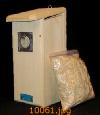
Coveside Three Woodpecker House
$49.95
Only a
few varieties of woodpeckers will live in a man-made box, but the Hairy,
Red-headed and Red-bellied Woodpeckers regularly do so.
This house comes with wood chips and a slate predator guard to keep squirrels
from enlarging the entrance hole. RANGE: Resides throughout
the U.S. and Canada, and north to Alaska. Some northern birds move south for the
winter. HABITAT: Lives in or at the edge of open woods,
prefering deciduous forests. (17-1/2"h x 7-1/2"w
x 9-3/4"d)
|
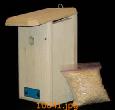
Coveside Titmouse/Warbler/Swallow Bird House
$31.95
Titmice are generally comfortable around people.
Prefer a natural habitat in areas with tall vegetation and a forest with a dense
canopy of trees. House also suitable for Prothonotary
Warblers, Tree Swallows, House Finches, Violet-green Swallows & Carolina
Wrens. RANGE: Resides in southern Wisconsin, southern
Michigan, central New York, southern New England south to Gulf of Mexico and
central Florida. HABITAT: Thrives in deciduous, coniferous
forests; swamps, orchards, suburban shade trees. (12-1/2"h x 6"w x
8-1/2"d)
|
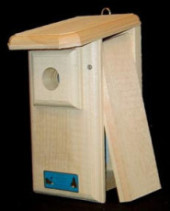
Coveside Western Bluebird House
$37.95
Needing
a slightly larger chamber and entrance hole than their eastern counterpart, this
house is ideal for the vivid Western Bluebird. RANGE:
Breeds in throughout the West, north from western Alberta and southern British
Columbia, south down the West Coast to Baja and east to eastern New Mexico and
western Texas. Winters within most of the breeding range.
HABITAT: Loves open woodlands and pastures. (12-1/2"h x 6-3/4"w x 9"d)
|
Coveside Wildlife Feeder
$69.95
This
feeder is for all the varied wildlife that may inhabit your backyard including
ducks, raccoons, squirrels, goats, whatever! Wood hopper
holds 5 quarts of feed, which dispenses food to trays on both sides to feed
creatures for days. (18"h x 15"w x
15"d)
|
Coveside Window Feeder
$44.95
This
newly improved window feeder has a platform with a perforated metal seed tray.
It easily attaches to the windowsill and allows viewing of
birds close at hand. The clear top gives a view of the birds from above. Roof
has low front opening to let in the little favorites, like titmice and
chickadees, while discouraging larger birds such as starlings and Blue
Jays. (8-1/2"h x 16"w x
11"d)
|
Coveside Window Suet Feeder
$24.95
Woodpeckers, nuthatches and chickadees will come right up to the
window to peck at the suet in this feeder. Installs simply
on any window with two oversized suction cups. Pull the pin and turn the roof to
the side to slide another suet cake to keep your visitors happy. (7"h x 7"w x 3"d)
|
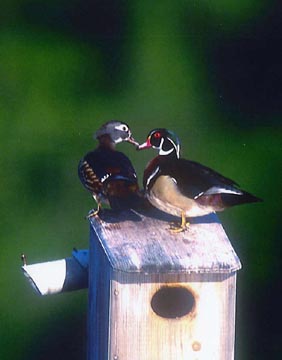
Coveside Wood Hooded Merganser Duck House
$69.95
Coveside's Wood Duck House opens two ways for
observation and cleaning, and has an internal ladder for the duckings to climb
out. Mother calls ducklings to the protection of the open
water at age one day. RANGE: Breeds from British Columbia
south to California, and from Montana east to Nova Scotia, and south to Texas
and Florida; absent from Rocky Mountains and Great Plains. Winters near Pacific
Coast north to Washington, and to New Jersey in East, rarely further north.
HABITAT: Nests beside wooded rivers and ponds. Visits
freshwater marshes in late summer and fall. (24-1/4"h x 11"w x 15"d)
|
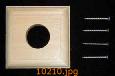
Coveside Wood Predator Guard
$5.95
Used to protect
baby birds form predators reaching in and grabbing
them.
|
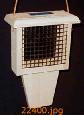
Coveside Woodpecker Suet Feeder
$29.95
This
feeder is designed to appeal to woodpeckers and flickers that are particularly
attracted to suet in winter. The ""paddle"" below the suet
cage provides a support for these birds to balance with their tails. Also loved
by chickadees and nuthatches. (12"h x 8"w x
4"d)
|
1 2
Support The Registry of Nature Habitats - Buy Conservation Credits For purchasing Conservation
Credit(s) You will receive a copy of the John Audubon Multimedia
CD A replica of the complete
(1840-1844) James Audubon's
Birds of America
You will also receieve a bluebird
house for each Conservation Credit purchased and a 20% off coupon to be used on
the A Bird's Home website!
 The Registry of Nature Habitats - Mission
Statement
The Registry of Nature Habitats is
dedicated to the preservation of land that, over time, has been a
site and home for complex ecosystems. The Registry advocates
preservation of these lands and its inhabitants, environmental
education for community individuals and groups, and nurturing of
these lands through restoration in order to conserve its
natural resources for future generations.
Preserve
The Registry of Nature
Habitats manages critical habitat, consisting of wetland,
lowland, upland, forest and stream habitat, providing a home
to wildlife species and plant species. As part of
the mission to preserve these lands and its inhabitants,
the Registry will continue to contract with owners
of ecologically sensitive land as it becomes
available.
Educate
The Registry of Nature Habitats is
a "teaching ground," able to provide hands-on, interpretive learning
experiences in areas such as ecology, botany, wildlife science, and
geology, as well as the arts and humanities. The
educational mission of The Registry of Nature Habitats is
to teach an understanding and appreciaton of the environment,
the invaluable lesson of land stewardship of our natural resources,
and to expand the general knowledge of this habitat through
scientific research. This will be accomplished through a
year-round experiential, interactive approach, along
with onsite and outreach activities including providing
educational material both on this website, on media and through
educational seminars. An on-site facility is in the
design phase, which will house classrooms and an administrative
space.
Nurture
Through several restoration
projects, including the rebuilding of stream corridors,
reintroducing native flora, and permitting only low-impact
activities, the Registry is nurturing much land back to
its natural state, undoing the damage of hundreds of
years. The Registry of Nature
Habitats restoration plan, developed with public and private
partnerships and with local community support, will increase
the land's value, enhance wildlife habitat, improve water
quality, and preserve the integrity of the land's
bio-diversity. Renewable
Energy
Promote the use of
renewable and efficient energy technologies through education,
training, workforce development, research, and project facilitation.
The Registry supports clean energy development and energy
conservation as the means to protect the environment, enhance
public health, and save our nature
habitats.
Conservation
We seek to educate people and provide innovative
solutions that will help build a clean, more efficient world, by
reducing energy consumption in a prudent way that does not
threaten the natural balance that supports all
life.
|
|
|