logosm.jpg

 
Ask Us A Question Here
 
A Bird's Home
 
A Birder's Resources
 
Become an Affiliate
 
Dealer Wholesale Account Information
 
Product Reviews
 
The Registry of Nature Habitats Certification
 
Dealer Account Information
 
Cypripedium - Lady Slipper Orchids
Bird feedersBirdhousesBird Houses Bird Feeders

Search for products for sale only!

Click on any product image to see larger image of product.
Bookmark - Add us to your Favorites

>


Google

Chickadees

ATTRACTING CHICKADEES!

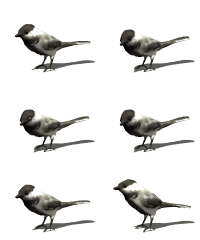
The chickadee is a part of the Titmouse family. This small and perky bird is a familiar and welcome visitor to our backyard feeders and gardens in winter. There are five species in North America, the black capped chickadee which makes its home to the north, the Chestnut backed chickadee found in the Pacific Northwest, the Carolina chickadee which is found in the south east, the mountain chickadee found in the west, and the Mexican chickadee found in the mountains of southeastern Arizona, southwestern New Mexico and the west and central mountainous areas of Mexico.

Chickadees are usually seen in pairs or small groups. When nesting is over and the young are on the wing, chickadees will form small flocks of 8 or a dozen birds which will roost and forage together until spring. Finding food in the winter is often tough and hunting in groups increases their chances for success. This group concept also helps as a predator defense system. More eyes can look for and warn the group of approaching danger.

Chickadees dine primarily on insects, seeds and berries. These active and agile little birds can be seen hanging upside down from twigs or at your feeder.

Attracting Chickadees to Your Backyard!

The chickadee is largely an insect eater. The constantly active chickadee will hop around and cling to twigs, branches, and foliage gleaning huge quantities of insect eggs and larvae. Chickadees also enjoy a variety of seeds and berries.

Pine seeds are an important natural vegetable food along with the seeds and nuts of hemlock, birch, pine, walnut, ragweed and sunflower. Chickadees love black oil sunflower seed   presented at your bird feeder. They will typically take one seed from the feeder, fly away and perch nearby to eat it. Chickadees will visit your feeder one at a time, while other chickadees wait nearby for their turn. They also enjoy gray striped sunflower seeds, peanut kernels, hulled sunflower seeds, peanut butter mixes and suet.

Chickadees enjoy the berries of poison ivy, blueberry, bayberry, and serviceberry.

 Chickadees are in constant motion and will appreciate lots of high energy food. Offer plenty of suet!

  1. Plant hemlock in your backyard or plant a pine, birch, aspen or elm tree. Create dense plantings of shrubs and young sapling thickets, backed by mature deciduous and coniferous trees.
  2. Plant berry producing bushes such as blueberry, elderberry and bayberries.
  3. The Chickadee will be a frequent visitor to your feeders in the winter. Fill your tubular perching feeders or hopper feeders with black oil sunflower seed or peanut kernels.
  4. Chickadees are one of the easiest birds to hand tame. Offer peanut or walnut kernels in your outstretched palm and watch them up close!
  5. Place out a platform feeder   and fill it with peanut kernels and fresh or dried blueberries.
  6. Offer a suet feeder   placed near the trunk of a tree.
  7. Smear peanut butter onto tree trunks and branches.
  8. Offer a source of water for drinking and bathing.
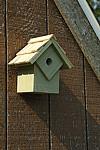
  9. Chickadees are cavity nesting birds, sometimes nesting in abandoned woodpecker holes and the natural cavities of trees. Most often they dig their own nesting holes out of partially rotted tree trunks or stumps. Put out a couple of chickadee specific bird houses   to encourage them to nest in your backyard. ( See specific nest box dimensions for the chickadee . ) Place small wood chips inside to persuade them to use it. They won't use the wood chips for nesting, but this lining will convince them that the nesting box is fresh and acceptable. Mount the box on the trunk of a pine, birch, aspen or elm tree.

Support

The Registry of Nature Habitats - Buy Conservation Credits


For purchasing Conservation Credit(s)
You will receive
a copy of the John Audubon Multimedia CD
A replica of the complete (1840-1844)
James Audubon's Birds of America

You will also receieve a bluebird house for each Conservation Credit purchased and a 20% off coupon to be used on the A Bird's Home website!


Conservation Certificates

The Registry of Nature Habitats - Mission Statement

The Registry of Nature Habitats is dedicated to the preservation of land that, over time, has been a site and home for complex ecosystems. The Registry advocates preservation of these lands and its inhabitants, environmental education for community individuals and groups, and nurturing of these lands through restoration in order to conserve its natural resources for future generations.

Preserve

The Registry of Nature Habitats manages critical habitat, consisting of wetland, lowland, upland, forest and stream habitat, providing a home to wildlife species and plant species. As part of the mission to preserve these lands and its inhabitants, the Registry will continue to contract with owners of ecologically sensitive land as it becomes available.

Educate

The Registry of Nature Habitats is a "teaching ground," able to provide hands-on, interpretive learning experiences in areas such as ecology, botany, wildlife science, and geology, as well as the arts and humanities. The educational mission of The Registry of Nature Habitats is to teach an understanding and appreciaton of the environment, the invaluable lesson of land stewardship of our natural resources, and to expand the general knowledge of this habitat through scientific research. This will be accomplished through a year-round experiential, interactive approach, along with onsite and outreach activities including providing educational material both on this website, on media and through educational seminars. An on-site facility is in the design phase, which will house classrooms and an administrative space.

Nurture

Through several restoration projects, including the rebuilding of stream corridors, reintroducing native flora, and permitting only low-impact activities, the Registry is nurturing much land back to its natural state, undoing the damage of hundreds of years. The Registry of Nature Habitats restoration plan, developed with public and private partnerships and with local community support, will increase the land's value, enhance wildlife habitat, improve water quality, and preserve the integrity of the land's bio-diversity.

Renewable Energy

Promote the use of renewable and efficient energy technologies through education, training, workforce development, research, and project facilitation. The Registry supports clean energy development and energy conservation as the means to protect the environment, enhance public health, and save our nature habitats.

Conservation

We seek to educate people and provide innovative solutions that will help build a clean, more efficient world, by reducing energy consumption in a prudent way that does not threaten the natural balance that supports all life.


Duck Decoy Loon Lake Heartwood magnolia Coast

Wholesale Dealer Inquiries Invited

Home Page | Product Review Page | Join Our Affiliate Program | Links | Help

Favorite Bird Guestbook | All About Purple Martins
Contact Us | Report Site Errors | Suggestions/Comments | Privacy Notice
Voting Booth | Site Survey | Bird & Nature Link Resources | Bird & Nature Bulletin Board

Visit The Registry of Nature Habitats and apply to admit your property. Receive many benefits in addition to 10% discount on all products offered by A Bird's Home.

Tell A Friend About This Web Site:

Your Name
Your Email
Friend's Name
Friend's Email
A Quick Note

Privacy Info: We DO NOT store your name, your email, your friends name, or your friends email in any form. It is ONLY used to generate an email message.

Join Our Mailing List!
Email First Name Last Name

Visit Our Partners:

Natural Gardens | Jim Miller Golf | Reigning Cats & Dogs | A Pond's Home | A Plant's Home | Sawkill Forest| An Instrument's Home


Bird feeders
(607) 746-3089
PO Box 321
Meridale, NY 13806
More information Help Desk

Copyright � 1997- Woodside Gardens
Last Updated: