

   |
 |
|
|
|
The eastern bluebird is a favorite migratory songbird of birders and nonbirders alike. The bird's bright blue color and melodious song make it a welcome visitor to backyards. The history of the bluebird spans a series of struggles and successes and only recently, through active wildlife management, has its future been considered secure. During the days of frontier settlement, the bluebird was among the wildlife species that benefited from the decimation of the eastern forests. The conversion of forest into pasture, orchards, and homesites created an abundance of ideal bluebird habitat - open areas that supported the nesting and foraging activities of the species. Farmers unintentionally assisted bluebirds by bordering their fields with wooden fence posts, thus supplying additional nesting sites. Combined, these factors led to a proliferation of bluebird numbers throughout the eastern United States through the mid-1800s. However, this situation changed in the late nineteenth century with the introduction of the European starling and the English house sparrow. In the twentieth century, increased use of harmful pesticides, replacement of wooden fence posts with metal posts, clearing of field borders and fence rows to increase cropland acreage, and a growing human population also contributed to population reductions. Fortunately, the favored status of the bluebird and its acceptance of artificial nesting structures has led to increased efforts to boost its populations to sustainable levels. Placement of thousands of nest boxes by concerned individuals has contributed significantly to ensuring a future for the eastern bluebird. The ongoing recovery of the eastern bluebird is an example of how sound wildlife management practices have been used to increase the survival success of an individual wildlife species. This pamphlet is designed to serve as an introduction to the habitat requirements of the eastern bluebird and to assist in the development of a comprehensive bluebird management plan. The success of any individual species management plan depends on targeting the specific needs of the species and analyzing the designated habitat areas as a whole to ensure that all required habitat elements are present. This guide also provides recommendations for program monitoring to document successes and to ensure that problems are addressed as they arise. Anonymous. 1999. Eastern Bluebird (Sialia sialis). U.S. Department of Agriculture, Natural Resources Conservation Service, Madison, MS, and Wildlife Habitat Council, Silver Spring, MD. Fish and Wildlife Habitat Management Leaflet No. 2. 12 pages. Jamestown, ND: Northern Prairie Wildlife Research Center Home Page. http://www.npwrc.usgs.gov/resource/1999/eastblue/eastblue.htm (Version 16AUG99). |
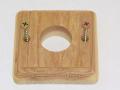 Bird House Guard
Description: 7/8" Natural Cedar w/fully routed edges. 1-1/2" or 1-1/4" Hole. Comes with 2 mounting screws. Dimensions: 3-1/4" L x 3-1/4" H  |
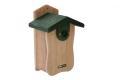 Bluebird House w/Viewing Window
Description: 7/8" Inland Red Cedar w/green or burgundy roof for long lasting outdoor use. All screwed construction using weather-resistant plated deck screws and fully routed edges. Overhang roof, vents and drainage holes keep nest dry and cool. Predator-resistant entrance hole. Front wall screen helps chicks climbing to the entrance hole. Side-opening door with plexy insert for viewing removes for easy cleaning. Comes with mounting screws. Dimensions: 9" L x 7-3/4" W x 14" H |
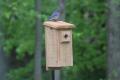 Bluebird House
Description: 7/8" Inland Red Cedar for long lasting outdoor use. All screwed construction using weather-resistant plated deck screws and fully routed edges. Overhang roof, vents and drainage holes keep nest dry and cool. Predator-resistant entrance hole. Front wall screen helps chicks climbing to the 1-1/2" or 1-9/16" entrance hole. Side door opens for easy cleaning. Comes with mounting screws. Dimensions: 8-1/2" L x 7-1/4" W x 15-3/4" H |
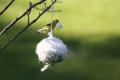 Cottontail Nest Building Ball Set of Three
Description: Combination of 100% cotton and yarn tails. Comes complete and ready to hang. 2 oz. |
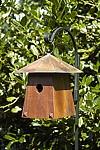 Heartwood Avian Bungalow Birdhouse
Ever noticed the graceful lines and angles of a migrating flock? We have, and it inspired this Craftsman style bungalow. Gently sloping body topped with a hand-burnished copper roof and large hanging loop. Bronze nail heads detail the front; copper cleanout door in back. Happy landings! Dimensions: 8" x 8" x 12" - 1-3/8" hole |
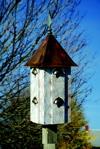 Heartwood Avian Estates Birdhouse
We heard you, and we agreed: Time to bring back this timeless classic. Eight magnificent compartments each with its own stylish shell awning set against Heartwood's Olde World finish and topped by a solid copper roof and cast iron finial. Listen to your birds-they're spreading the word. Avian Estates is back! |
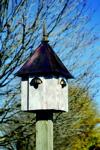 Heartwood Avian Meadows Birdhouse
Duplex version of our popular Avian Estates, with all the same luxury as the original. 2 perfectly sized compartments-one fabulous house! Dimensions: 13" x 24" with 1 ½" hole |
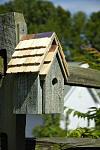 Heartwood Bluebird Manor Birdhouse
Bluebirds were there to welcome the first settlers of Plymouth Colony, who called them blue robins. Now you can return the hospitality with the royal welcome of Bluebird Manor. Solid cypress construction features our famous stone-washed shingled roof, solid copper trim and hinged front door for east access, viewing and cleaning. Excellent floor drainage and roof ventilation, with mounting paddle for easy hanging. Expect pilgrims shortly! Dimensions: 8" x 8" x 16" - 1-1/2" hole |
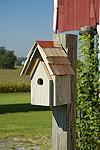 Heartwood Bungalow Birdhouse
Thinking small can yield huge rewards, as here with our beloved Bungalow, a cozy version of our popular Bluebird Manor, with small interior dimensions (6" x 5") and hole. Select cypress construction features hand-cut shingles, copper trim and a finish of your choice of all-weather stain. With excellent ventilation and drainage, convenient real clean-out and a galvanized metal hanging loop for immediate gratification. |
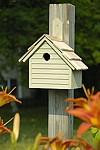 Heartwood Cape Cod Wren Birdhouse
Ahoy! Birdsongs ahead as new residents sail right in! Charming New England design finished with beautiful Heartwood shingled roof, copper trim and rich semi-transparent stain (non-toxic, of course!) give this home real character, while great ventilation and drainage and convenient rear clean-out door mean years and years of delightful use. Dimensions: 6" x 10" x 12" - 1-1/4" hole |
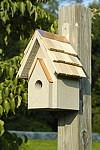 Heartwood Classic Birdhouse
What you see here is a classic case of top-down quality beginning with the distinctive Heartwood roof: copper-trimmed and shingled, with each shingle hand cut and stone washed for the all-cypress construction that also offers excellent drainage and ventilation and a convenient mounting paddle. Dimensions: 6" x 6" x 12" - 1-1/4" hole |
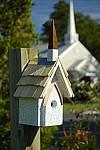 Heartwood Classic Chapel Birdhouse
The little piece of birding heaven comes complete with crackle finish, solid ast iron steeple and a copper cleanout door. Your flock will approve--choirs will sing! Dimensions: 6" x 7" x 16" - 1-1/4" hole |
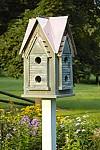 Heartwood Copper Mansion Birdhouse
They searched high and low for their dream house ever since they met in the branches of a maple tree. Yet nothing seemed suitable. Then, on a fly-over, the dramatic four-valley solid copper roof caught their attention. Eye level, it was love at first sight. And how could it not be, with this kind of craftsmanship? Reverse board and batten vertical siding with side modules of beveled horizontal siding and eyebrow gables. The neighbors are wonderful--8 compartments in all. You'll love the easy cleaning thanks to removable roof. Dimensions: 15" x 15" x 27" - 2-1/4" hole |
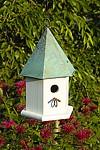 Heartwood Copper Songbird Birdhouse
There's always another side to your love for birds, and here you see six of them in a stylish hexagonal body of solid cypress and six-sided solid copper roof. Hanging loop and matching copper perch complete the look, with easy cleanout and optional easy mounting. Dimensions: 7" x 7" x 15" - 1-1/4" hole |
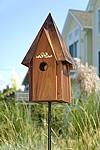 Heartwood Cotswold Cottage Birdhouse
In the Middle Ages, it was believed that February 14 was the day songbirds chose their mates. The first known Valentine was Chaucer's love poem "A Parliament of Fowls" honoring the wedding of King Richard II. Here, this honeymoon cottage honors that tradition of happy endings (and happy beginnings and middles) with fairy tale charm. Solid copper roof is pitched pleasingly high, with a patina yielding forever-after beauty. Dimensions: 9" x 9" x 18" - 1-1/2" hole |
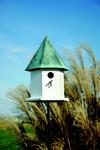 Heartwood Deluxe Copper Songbird Birdhouse
People were singing the blues-our Copper Songbird wasn't sized for bluebirds. Here, our correction, a version with perfect bluebird dimensions and exceptional songbird satisfaction. Dimensions: 10" x 10" x 18" with 1 ½' hole |
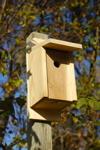 Heartwood Eastern Bluebird Joy Box Birdhouse
John James Audubon did some of his most famous bird drawings as he explored on foot along the Natchez Trace, which happens to be located near Star, Mississippi, where we design and make all our Heartwood homes. While birding has come a long way since Audubon's time, today with our four-season nesting boxes and basic homes, you don't need to go to anywhere to enjoy all manner of wonderful bird life flocking to your door. Discreet complements to any landscape, these hardy havens are convenient, long lasting and beautiful-the picture perfect start to your life in birding! Season after season, this delightful nesting box is a joy to behold and a breeze to maintain thanks to easy twist latch and slide-front panel that also inverts for winter roosting. So easy to use, so easy to love, it turns birding into child's play! Rugged construction features 13/16" solid cypress and headed ring shank stainless steel nails. |
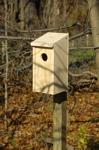 Heartwood Flicker Joy Box Birdhouse
John James Audubon did some of his most famous bird drawings as he explored on foot along the Natchez Trace, which happens to be located near Star, Mississippi, where we design and make all our Heartwood homes. While birding has come a long way since Audubon's time, today with our four-season nesting boxes and basic homes, you don't need to go to anywhere to enjoy all manner of wonderful bird life flocking to your door. Discreet complements to any landscape, these hardy havens are convenient, long lasting and beautiful-the picture perfect start to your life in birding! Season after season, this delightful nesting box is a joy to behold and a breeze to maintain thanks to easy twist latch and slide-front panel that also inverts for winter roosting. So easy to use, so easy to love, it turns birding into child's play! Rugged construction features 13/16" solid cypress and headed ring shank stainless steel nails. Dimensions: 8" x 10" x 19"; 2 ½" hole |
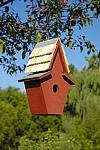 Heartwood Songbird Ranch Birdhouse
Watch your 'bird herd' head for this ranch house. Clever design using select cypress will make your backyard birds want to come and stay. A hanging hook makes mounting simple and quick. Cleanout, drainage, and ventilation complete this "home on the range". Dimensions: 7" x 9" x 13" - 1-1/2" hole |
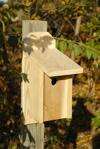 Heartwood Western Bluebird Joy Box Birdhouse
John James Audubon did some of his most famous bird drawings as he explored on foot along the Natchez Trace, which happens to be located near Star, Mississippi, where we design and make all our Heartwood homes. While birding has come a long way since Audubon's time, today with our four-season nesting boxes and basic homes, you don't need to go to anywhere to enjoy all manner of wonderful bird life flocking to your door. Discreet complements to any landscape, these hardy havens are convenient, long lasting and beautiful-the picture perfect start to your life in birding! Season after season, this delightful nesting box is a joy to behold and a breeze to maintain thanks to easy twist latch and slide-front panel that also inverts for winter roosting. So easy to use, so easy to love, it turns birding into child's play! Rugged construction features 13/16" solid cypress and headed ring shank stainless steel nails. Dimensions: 6 ½" x 10" x 17"; 1 9/16" hole |
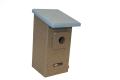 Recycled Bluebird House
Description: 5/8" Poly-lumber made from recycled plastic and milk jugs; lifetime guarantee to never crack, split or fade. Taupe base w/blue roof. Stainless steel screws. Side-opening door for easy cleaning. Front wall screen helps chicks climbing to the entrance hole. Predator-resistant 1-1/2" entrance hole and overhang roof. Mounting screws included. Dimensions: 6-5/8" L x 8" W x 12-5/8" H  |
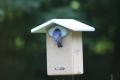 Recycled Ultimate Bluebird House w/Camera
Description: 5/8" Poly-lumber made from recycled plastic and milk jugs; lifetime guarantee to never crack, split or fade. Taupe base w/blue roof. Stainless steel screws. Opening side doors engraved with "clean" and "view". "View" door opens to a plexy glass viewing window. House has a raised screen floor to reduce blowfly infestations. Front wall screen helps chicks climbing to the entrance hole. Predator-resistant 1-1/2" entrance hole. Overhang roof, vents and drainage holes keep nest dry and cool. Mounting screws included. Comes with camera and 100' of cord that connects to your television to watch the nest. Dimensions: 11" L x 8-1/2 " W x 12-5/8" H |
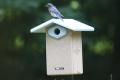 Recycled Ultimate Bluebird House w/Viewing Window
Description: 5/8" Poly-lumber made from recycled plastic and milk jugs; lifetime guarantee to never crack, split or fade. Taupe base w/blue roof. Stainless steel screws. Opening side doors engraved with "clean" and "view". "View" door opens to a plexy glass viewing window. House has a raised screen floor to reduce blowfly infestations. Front wall screen helps chicks climbing to the entrance hole. Predator-resistant 1-1/2" entrance hole. Overhang roof, vents and drainage holes keep nest dry and cool. Comes with mounting screws. Dimensions: 11" L x 8-1/2" W x 12-5/8" H |
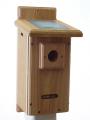 Standard Bluebird House
Description: 7/8" Inland Red Cedar for long lasting outdoor use. All screwed construction using weather-resistant plated deck screws and fully routed edges. Overhang roof, vents and drainage holes keep nest dry and cool. Predator-resistant entrance hole. Front wall screen helps chicks climbing to the 1-1/2" or 1-9/16" entrance hole. Side door opens for easy cleaning. Comes with mounting screws. Dimensions: 8-1/2" L x 7-1/4" W x 15-3/4" H |
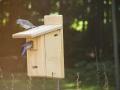 Ultimate Bluebird House w/Viewing Window
Description: 7/8" Inland Red Cedar for long lasting outdoor use. All screwed construction using weather-resistant plated deck screws, aluminum rust-resistant continuous hinges, and fully routed edges. Opening side doors engraved with "clean" and "view". "View" door opens to plexy insert for viewing. House has a raised screen floor to reduce blowfly infestations. Copper portal guard, 1-1/2" hole, vents and drainage holes, and long overhang. Comes with mounting screws. Dimensions: 7" L x 8-3/4" W x 15" H |
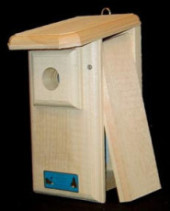 Coveside Eastern Bluebird House
The finest bluebird house on the market! Predator guard is standard to keep starlings, squirrels and other undesirables out, while small floor discourages sparrow nests. RANGE: Breeds east of the Rockies from southeastern Canada to Gulf of Mexico. Winters in southern part of breeding range and Mexico. HABITAT: Enjoys open woodlands, fields and farmlands with scattered trees. (12-1/2"h x 6"w x 8-1/2"d) |
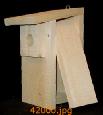 Coveside Economy Bluebird House
Same functionality as our standard Eastern Bluebird House, but a "no frills" variety without the pretty features that don't impress the birds. For those who want to put up an extensive bluebird trail at a reasonable price. (12-1/2"h x 6"w x 8"d) |
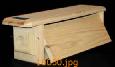 Coveside Horizontal Bluebird Box
Designed by Frank Zuern to be a safer nesting place for Eastern Bluebirds, this horizontal box simulates a hollow tree branch. Over 90% nest near the back of the box, behind a vertical baffle, out of the reach of predators. RANGE: Breeds east of the Rockies from southeastern Canada to Gulf of Mexico. Winters in southern part of breeding range and Mexico. HABITAT: Prefers open woodlands and farmlands with scattered trees. (6-1/4"h x 6"w x 19-3/4"d) |
|
Coveside Mountain Bluebird House
The largest of the bluebird houses, this box provides an ideal cavity for the only "all-blue" bluebird. RANGE: Breeds from southern Alaska, Mackenzie and Manitoba south to western Nebraska, New Mexico, Arizona and west to the coast. Winters from British Columbia and Montana south through western U.S. HABITAT: Breeds in high mountain meadows with scattered trees and bushes; in winter descends to lower elevations, where it prefers the plains and grasslands. (12-1/2"h x 7-1/4"w x 9"d) |
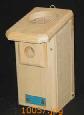 Coveside Open Top Bluebird House
This sparrow-resistant house, similar to our standard bluebird house, has a circular opening in the roof. Naturally, bluebirds will nest in rotten fence posts and stumps, so sun and rain do not deter them. On the other hand, sparrows are not as tolerant. A durable, coated wire barrier prevents predators from entering through the top. In addition, a plastic cap is included to provide shelter after the bluebirds have started nesting and/or can be used to feed mealworms to hungry chicks. RANGE: Breeds east of the Rockies from southeastern Canada to Gulf of Mexico. Winters in southern part of breeding range and Mexico. HABITAT: Enjoys open woodlands, fields and farmlands with scattered trees. (12-1/2"h x 6"w x 8-1/2"d) |
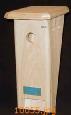 Coveside Slant Front Bluebird House
This design is popular because it discourages cats and other predators. Since the bottom tapers, less nesting material is needed. The front opens easily for observation and cleaning. Mount this box high on a post so that potential occupants can be easily observed from a distance. RANGE: Breeds east of the Rockies from southeastern Canada to Gulf of Mexico. Winters in southern part of breeding range and Mexico. HABITAT: Enjoys open woodlands, fields and farmlands with scattered trees. (17"h x 7"w x 9"d) |
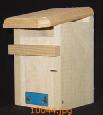 Coveside Sparrow Resistant Bluebird House
This Kentucky style, slot entrance bluebird house is designed to thwart sparrows. According to research at the University of Kentucky, bluebirds prefer a slot entrance to the standard circular hole -- sparrows prefer the opposite. In addition, sparrows don't like a shallow box and bluebirds don't seem to mind. This box is only 5" deep but if sparrows still continue to be a problem, a wooden insert is included to reduce the depth even more. Sparrows rarely use the 3-1/2" depth, but bluebirds will still occupy it. RANGE: Breeds east of the Rockies from southeastern Canada to Gulf of Mexico. Winters in southern part of breeding range and Mexico. HABITAT: Enjoys open woodlands, fields and farmlands with scattered trees. (10"h x 6"w x 8-1/2"d) |
|
Coveside Western Bluebird House
Needing a slightly larger chamber and entrance hole than their eastern counterpart, this house is ideal for the vivid Western Bluebird. RANGE: Breeds in throughout the West, north from western Alberta and southern British Columbia, south down the West Coast to Baja and east to eastern New Mexico and western Texas. Winters within most of the breeding range. HABITAT: Loves open woodlands and pastures. (12-1/2"h x 6-3/4"w x 9"d) |
|
Ads Installment loans are a very popular loan type that many people use to make large purchases such as a car or a home. While these loans are very useful, they are hard to get when you have bad credit. The good news is there is online installment loans slickcashloan.com to help. Slick Cash Loan specializes in helping people with bad credit get the installment loans they need. Visit today to apply for your installment loan. |
Home
Page |
Product Review Page | Help
 Woodside Gardens
The Registry of Nature Habitats
Woodside Gardens
The Registry of Nature Habitats 
 1999 -
All Rights Reserved
Last Updated: