|
INTRODUCTION
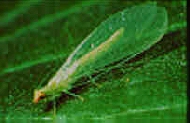
A common green lacewing (scientifically known as
Chrysoperla rufilabris) is widely used
in various situations to control many different
pests.
|
Many species of adult lacewings do not kill pest insects, they actually
subsist on foods such as nectar, pollen and honeydew. It is their
predacious offspring that get the job done.
The adult lacewing lays her eggs on foliage. Each egg
is attached to the top of a hair-like filament. After a few days the eggs hatch
and a tiny predatory larva emerges ready to eat the pests.
Lacewing larvae are also known as aphid lions. They
are tiny upon emerging from the egg, but grow to 3/8 of an inch long.
Lacewing larvae voraciously attack their prey by
seizing them with large, sucking jaws and inject a paralyzing venom. The hollow
jaws then draw out the body fluids of the pest. Of all available commercial
predators, this lacewing is the most voracious and has the greatest versatility
for pests of field crops, orchards, and greenhouses.
Each lacewing larva will devour 200 or more pests or
pest eggs a week during their two to three week developmental period. After this
stage, the larvae pupate by spinning a cocoon with silken thread. Approximately
five days later adult lacewings emerge to mate and repeat the life cycle.
Depending on climatic conditions, the adult will live about four to six weeks.
Each adult female may deposit more than 200 eggs. For
best results, habitats should be provided that encourage the adults to remain
and reproduce in the release area. Nectar, pollen, and honeydew stimulate their
reproductive process. If these food sources are not available, adults may
disperse. An artificial diet called Wheastis (Wheast is used at Beneficial
Insectary for the production of green lacewing. We mix our own diet which, when
mixed 50/50 with sugar, can be used by the grower as an attractant for lacewing
adults and other beneficial insects.), available to provide the
adults with the necessary nutrition they need for reproduction.
Wheast powder mixed with sugar and water is used at Beneficial
Insectary to help mass-rear the lacewing. Studies by universities and the USDA
have shown that spraying field crops with a Wheast/sugar/water mixture
increases egg laying considerably. Lacewing adults can survive the winter in
protected places but have a difficult time surviving cold winters.
PREY
Lacewing larvae feed on many different pest insects.
In general, they attack the eggs and the immature stages of most soft-bodied
pests such as: aphids, thrips, spider mites, sweet potato & greenhouse
whitefly, mealybugs, leafhoppers, and the eggs and caterpillars of most pest
moths.
When targeting caterpillars, lacewing used in
conjunction with Trichogramma wasps
can be very effective. Since Trichogramma attack only the egg stage,
the lacewing offers a second line of defense; it feeds on eggs and young
caterpillars. Information about the use of Trichogramma is available from
Beneficial Insectary, as are recommendations of pertinent scientific literature.
BETTER PEST MANAGEMENT USING LACEWING
Start early in the season as soon as pest insects are
detected. Monitoring is essential. Traps and lures can be very helpful tools for
establishing "start dates" and for predicting pest population levels. Initiating
natural enemy releases when pest populations are high does not lend itself to
successful augmentative biological control. The pest must be detected and
releases begun when infestations are at a manageable level. Because every
situation is different, numbers of lacewings required can vary significantly
from site to site. It is therefore important to monitor the beneficial insect
and pest populations.
Generally, it is best to start with early release of
a relatively low number of lacewings per acre or target planting. It is
essential to refrain from using broad spectrum chemicals in order to conserve
naturally occurring predators and parasites. Lacewings should be released every
10 - 15 days until their populations are easily detectable or pests are no
longer a threat.
|






 Woodside Gardens
The Registry of Nature Habitats
Woodside Gardens
The Registry of Nature Habitats 
 1999 -